Therapy
Child Abuse Service, Alberta Health Services
Child Abuse Service, Alberta Health Services
The Child Abuse Service, is a specialized, multidisciplinary service, through Alberta Health Services that supports children and youth ages 4–17 who have experienced abuse or neglect. The Child Abuse Service therapy team is co-located at Luna, as part of our multidisciplinary team. The program’s goal is to help children and youth heal and improve their emotional, behavioural, and overall well-being.

The therapy team works with children and youth who have been affected by:
Sexual abuse
Severe and complex physical abuse
Severe and complex neglect
The therapy team provides assessment and treatment to help children, youth, and families cope with emotional distress, behaviour changes, and relationship challenges related to these experiences.
The therapy team also offers assessment and treatment for problematic sexual behaviour concerns. For more information on this service, click here.
Therapy services are a self-referral service. What that means is that the legal guardian can make a referral by calling to complete an intake. We do not require a physician or other therapist to support the referral. Therapy referrals are accepted from: • Parents or legal guardians (self-referral) • Health services (internal referrals) • Community physicians • Children and Family Services caseworkers
A child may qualify for therapy if: • They have experienced sexual abuse, and/or severe and complex physical abuse and/or neglect, and • They are showing emotional or behavioural difficulties related to those experiences, and • They are under 18 years old at the time of referral
Child Abuse Service is not able to provide services for:
Assessments of parenting capacity
Situations where ongoing maltreatment is still occurring (e.g., active abuse, domestic violence, or caregiver substance use)
Requests to investigate, confirm, or obtain disclosures of abuse
Cases where abuse allegations have been unsubstantiated


If you’re unsure whether the Child Abuse Service is the right service for your child or youth, we encourage you to contact Central Access and Triage. Therapy team members can help guide you to the most appropriate support.
As a public health, community-based service, families are not required to have involvement with Luna, or police, to refer to the Child Abuse Service for therapy services.
To make a referral:
Contact the Central Access and Triage Team by phone at 403-428-5320.
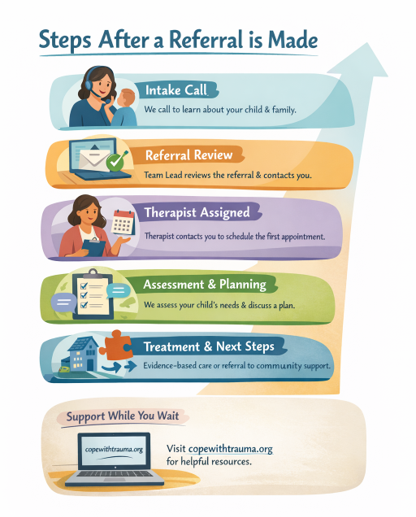
We know starting therapy can feel overwhelming. Here’s what typically happens once a referral has been made:
1. Intake call
Once you have called and left a message with Central Access and Triage Team, an Intake Clinician will contact you by phone to gather more information about your child’s experience, family, and your current concerns. After this call, the referral is sent to the Child Abuse Service Therapy Team Lead for review.
2. Referral review and confirmation
The Therapy Team Lead will review the referral and then contact you by email to let you know whether the referral has been accepted and to provide an estimated wait time. If the referral is not a fit for Child Abuse Service, we will provide recommendations for other services that may better meet your child’s needs.
3. Support while you wait
Visit www.copewithtrauma.org for helpful resources.
4. Therapist assignment and first appointment
Once your child is ready to be seen, a therapist will reach out directly to schedule the first appointment.
5. Assessment and treatment planning
The therapist will complete an assessment to better understand your child’s strengths, needs, and goals. Once the assessment is done, they will discuss recommendations with you.
6. Treatment and next steps
Treatment recommendations may include: (1) Evidence-informed treatment provided within Child Abuse Service, or (2) a possible referral to a community agency if another service would be more appropriate.
As a public health, community-based service, families are not required to have an open file with Luna to refer to the Child Abuse Service for therapy services.
To refer a child or youth to therapy, please call AHS Central Access at Triage at 403-428-5320.
There is no set limit on the number of sessions. Most children and youth are seen weekly for one-hour sessions. The length of treatment will vary depending on your child or youth’s needs. On average, families work with us for about one year, however, this depends on the needs of your child or youth.
The purpose of the assessment is to gather a comprehensive understanding of the child or youth’s experiences and current needs following a disclosure of abuse. Information is collected from caregivers or guardians, the child or youth (in an age-appropriate and trauma-informed manner), and, when relevant, other professionals involved in the child’s life.
The assessment may include interviews, questionnaires, and behavioural observations to better understand the impact of the disclosed abuse on the child or youth’s emotional wellbeing, development, and overall family functioning. This information is carefully integrated to inform evidence-based treatment recommendations tailored to the child and family’s unique strengths, needs, and circumstances.
Evidence-informed treatment means the therapy approaches we use are based on research and best clinical practices. These treatments have been shown to help children and youth recover from trauma and improve emotional and behavioural wellbeing. The Child Abuse Service Therapy Team offers treatments such as: Trauma-Focused Cognitive Behavioural Therapy, Dialectical Behavioural Therapy for Adolescents, Eye Movement Desensitization and Reprocessing Therapy, Modified Parent-Child Interaction Therapy, Circle of Security Parenting, and Connect Parenting Group.
Your child’s therapist will also tailor treatment to your child’s age, experiences, strengths, culture, and family situation.
Yes. Non-offending caregivers are an important part of a child’s healing.
Depending on your child’s age and needs, caregivers may:
Join some therapy sessions
Learn ways to support their child at home
Get help understanding and responding to trauma related behaviours
Caregivers may also be invited to take part in parent groups, such as Circle of Security Parenting (COSP), Connect, or Dialectical Behaviour Therapy for Adolescents (DBT-A) Multifamily Skills Group. These groups help caregivers better understand their child’s needs and build stronger, more supportive relationships.
Your therapist will talk with you about what type of involvement makes the most sense for your family.
While you’re waiting for services, families can access free, trusted resources here.
The COPE website was developed in partnership with the University of Calgary and Child Abuse Service therapists. It offers practical, evidence-based information to help caregivers understand trauma and learn ways to support their child at home, including:
Understanding trauma and trauma responses
Parenting strategies and coping tools
Ways to support your child’s emotional and behavioural needs
Resources for caregiver well‑being
These resources are not a replacement for therapy, and many families find them helpful while waiting or alongside treatment.
It is your legal duty to report suspected child abuse. Reports of child abuse should not be made directly to the Luna Centre.